
8 Letter Words in Your Writing
You probably don’t think much about word length when you’re writing an email, crafting a social post, or putting together a report. But here’s the thing your choice of words matters way more than you realize. Specifically, 8 letter words sit in this sweet spot between being sophisticated enough to sound intelligent and accessible enough that readers don’t need a dictionary.
Think about it. Short words feel choppy. Long words feel pretentious. But They’re like Goldilocks territory. They’re just right.
In the world of professional communication, SEO optimization, and content marketing, punch above their weight. They carry authority. They convey expertise. They make your audience pay attention without making them work too hard. Whether you’re running a business, managing a team, or building your personal brand online, understanding how to use these words effectively will change your writing forever.
Let me walk you through why this matters and how to use it to your advantage.
What Makes 8 Letter Words So Effective
The Psychology Behind Word Length
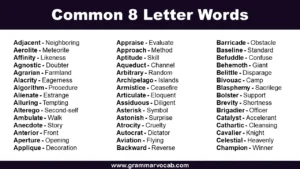
Your brain processes information at lightning speed. When someone reads your content, they’re making instant judgments about whether it’s worth their time. Word length plays a surprising role in this decision-making process. Research in cognitive science shows that words with seven to nine letters trigger a specific response in the reader’s brain they signal competence without creating friction.
feel authoritative. They’re not too casual like “hi” or “think.” They’re not too formal like “establishment” or “particularly.” This makes them perfect for virtually every context. Business writing? Check. Blog posts? Absolutely. Social media? Yes, even there.
Consider the difference between these sentences:
“Use simple words in your writing.”
“Implement distinct vocabulary in your writing.”
The second one carries more weight, right? “Implement” is an 8 letter word that sounds more intentional than “use.” “Distinct” (8 letters) feels more specific than “simple.” That’s the magic at work.
How Readers Perceive Authority
When readers encounter sprinkled naturally through your content, they unconsciously register your writing as more credible. This isn’t manipulation it’s just how human psychology works. We associate certain word choices with expertise and professionalism.
The key word here is “naturally.” Force a bunch of into your writing, and people smell it immediately. But weave them in organically? They won’t notice. They’ll just think you’re knowledgeable and well-spoken.
This is particularly important if you’re trying to rank in search engines. Google’s algorithms have become incredibly sophisticated at detecting natural language patterns. Writing that sounds human that includes varied vocabulary and natural rhythm ranks better than rigid, keyword-stuffed content.
The Best 8 Letter Words for Professional Communication

Words That Project Confidence
Let me share some of the most powerful 8 letter words you should be using:
“Complete” – This word signals finality and thoroughness. “We’ve completed the project” sounds more accomplished than “We’ve finished the project.”
“Identify” – Whether you’re analyzing data, solving problems, or conducting research, “identify” carries scientific credibility. It suggests careful observation and thought.
“Generate” – Perfect for any context involving creation or output. It sounds more dynamic than “make” or “create.”
“Evaluate” – Use this when you’re assessing something. It implies careful consideration and professional judgment.
“Discover” – This word taps into the human love of finding something new. It’s particularly effective in marketing and educational content.
“Document” – When you need to sound official and methodical, this word delivers. “We documented the findings” sounds professional and thorough.
“Building” – Simple enough, but it suggests growth and construction. “We’re building our team” sounds more dynamic than “We’re hiring.”
“Specific” – Precision matters in professional writing. Using “specific” shows you’re detail-oriented.
Words That Convey Growth and Movement
Your audience wants progress. They want to feel momentum. Certain tap into this desire:
“Increase” – Universal and clear. Everyone understands you mean growth.
“Improve” – Whether it’s performance, quality, or efficiency, this word signals positive change.
“Enhance” – Similar to improve but sounds slightly more elegant and polished.
“Progress” – Whether used as a verb or noun, this word resonates with people who care about moving forward.
“Optimize” – In the tech and business world, optimization is everything. This word shows strategic thinking.
Words That Build Trust
Your readers need to trust you. These words help establish that:
“Reliable” – When something is reliable, people count on it. Perfect for describing your service or product.
“Maintain” – This word suggests stability and consistency. “We maintain high standards” is powerful.
“Preserve” – Use this when you’re emphasizing continuity or protecting something valuable.
“Validate” – This word suggests verification and proof. “Our results validate our approach” is compelling.
Integrating 8 Letter Words Into Your SEO Strategy
Why Search Engines Love Natural Language
Google doesn’t reward keyword stuffing anymore. It hasn’t for years. What Google does reward is natural, human-sounding content that answers user questions comprehensively. Using 8 letter words effectively is actually one way to demonstrate this natural language quality.
When you write naturally, your keyword density falls into the right range automatically. You’re not forcing words. You’re using the best word for the job, and sometimes that word happens to be your target keyword. Sometimes it doesn’t. Either way, your content reads like it was written by a real human with expertise, not a robot.
This is where become an SEO asset. They help you achieve that sweet spot of readability and relevance. Your content becomes easier for both humans and algorithms to understand.
Keyword Research Insight
If you’re targeting “8 letter words” as a keyword which is literally what we’re doing here you want to approach it strategically. Don’t just jam the phrase everywhere. Instead, integrate it into natural sentences:
“Learning which 8 letter words work best in your industry is a skill that separates average writers from exceptional ones.”
“The most successful copywriters understand that create a specific tone and credibility level.”
See? The keyword appears, but the sentences sound human. That’s the goal.
Real World Applications: Where 8 Letter Words Matter Most
Email Marketing and Professional Correspondence
Your emails set the tone for your professional relationships. When you open with “We’re pleased to present our solution,” you’ve already used two 8 letter words (“pleased” and “present”) that feel refined.
Compare this to “We’re happy to show you our solution.” Both convey roughly the same message, but the first one feels more polished. That matters.
In email marketing specifically, subject lines with 8 letter words often outperform overly casual alternatives:
- “Discover why leaders choose our platform”
- “Improve your business in 30 days”
- “Validate your strategy with real data”
These subject lines have punch. They use powerful 8 letter words that make people curious.
Content Marketing and Blog Posts
If you’re writing blog content which is increasingly important for building authority online help you sound like an expert without sounding like you’re trying too hard.
Good blog writing feels like a smart friend explaining something they know well. It’s not stiff. It’s not overly technical. It’s conversational but elevated. That’s the sweet spot where live.
When you’re explaining concepts, these words help you sound credible:
“Let me explain the research behind this approach.”
“I’ve observed that certain strategies perform better.”
“The solution involves combining multiple elements.”
Each of these sentences uses naturally. They’re not the focus. They’re just the right words for the job.
Social Media and Personal Branding
Even on social media, where brevity reigns, have their place. They help you stand out in crowded feeds. Most social media posts are written casually, with short, punchy words. When you occasionally elevate your language with an 8 letter word, it signals sophistication:
“Building a personal brand requires consistent effort and genuine engagement.”
That sentence wouldn’t look out of place on LinkedIn. It uses “Building,” “personal,” “requires,” and “consistent” all 8 letter wordsin a totally natural way.
The Common Mistakes People Make with Word Length
Overdoing It
The biggest mistake is trying to use too many long words. This backfires immediately. Your writing becomes stilted and hard to read. People notice when you’re showing off your vocabulary.
Balance is essential. Mix your with shorter words. Short words create speed and energy. Long words create weight and authority. Together, they create rhythm.
A good rule of thumb: if more than 10-15% of your words are 8+ letters, you might be pushing it. Let the shorter words do their job.
Using the Wrong Words
Just because a word has 8 letters doesn’t mean it belongs in your sentence. Always choose clarity first. If a 5-letter word says exactly what you mean, use it. Don’t force an 8 letter word just because.
The art is in using where they actually improve your message. Not where they add nothing but length.
Ignoring Context
An 8 letter word that works perfectly in professional content might feel out of place in a text message to a friend. Context matters. You’re not trying to use these words everywhere. You’re trying to use them strategically in places where they elevate your communication.
Practical Exercises to Master This Skill
The Rewrite Challenge
Take something you’ve written. Now rewrite it, replacing at least three words with that carry the same meaning:
Original: “We make tools that help people work better.”
Revised: “We develop solutions that enhance professional productivity.”
Notice how the revised version sounds more polished? That’s what strategic word choice does.
The Reading Audit
Read articles from writers you admire. Note when they use and what effect it creates. You’re reverse-engineering their technique.
The Sentence Rhythm Test
Write a paragraph. Then read it aloud. Do the sentences have rhythm? Do they flow? Short sentences should follow long ones. Dense vocabulary should be balanced with simple words. Your ear will tell you if something’s off.
Advanced Strategies: Combining Multiple Elements
Using 8 Letter Words in Headlines
Your headline is the most important line you write. It determines whether someone reads the rest of your content. Strategic in headlines work because they signal value:
“Discover That Increase Sales”
“How Experts Improve Writing Quality Instantly”
“Building Authority Through Strategic Vocabulary”
These headlines use in the main message, not buried randomly. The words carry the core benefit.
Creating Emphasis with Word Choice
When you want to emphasize something important, surround it with 8 letter words:
“This strategy delivers measurable, tangible results.”
“Deliver” is 7 letters, “measurable” is 10, but “tangible” is 8. The combination creates emphasis and credibility.
The Bottom Line: Why This Matters for Your Success
Whether you’re writing marketing copy, business emails, content, or social posts, your word choices shape how people perceive you. Small details matter. Really matter.
Using strategically makes you sound more professional, more knowledgeable, and more trustworthy. It’s not about pretending to be something you’re not. It’s about choosing your words with intention.
The writers, marketers, and communicators who understand this have an advantage. Their writing gets better results. Their messages land harder. Their authority grows.
You don’t need to overthink this. You don’t need to memorize lists of . You just need to be intentional. When you’re writing something important, pause before you choose a word. Ask yourself: “Is this the best word for this message?” Often, you’ll find that an 8 letter word sits somewhere in your vocabulary, waiting to be used.
Start paying attention to word length. Notice how it affects your reading experience. Then apply what you notice to your own writing. That awareness alone will improve your communication almost immediately.
Because here’s what the best writers know: mastery isn’t complicated. It’s just the accumulation of small, intentional choices. And choosing the right word length? That’s one of the most underrated choices you can make.
FAQ’S:
Q: What are some common examples of powerful 8 letter words I can use right now?
A: Great question. Here are some that work across most writing contexts: “feedback,” “research,” “teaching,” “analysis,” “training,” “planning,” “solution,” “customer,” “strategy,” “approach,” “provided,” and “personal.” Each of these works in professional communication without sounding forced. The key is using them where they naturally fit your message. Don’t search for sentences where they belong. Instead, when you need to describe something, one of these words usually works perfectly.
Q: Can using 8 letter words really improve my SEO rankings?
A: Sort of. The words themselves aren’t magic. What matters is that natural, varied vocabulary which includes 8 letter words—signals quality to search engines. Google’s algorithms have gotten smart about detecting human writing versus machine-generated content. When your content reads naturally and uses a mix of word lengths, it ranks better. But you’re not optimizing for. You’re optimizing for clarity and natural flow, which naturally includes them.
Q: How many 8 letter words should I use in a typical piece of content?
A: There’s no magic number. A good guideline: aim for 10-15% of your words to be 8+ letters. Anything more feels stiff. Anything less feels too casual. But honestly, don’t count. Just write naturally, then read it back. If it flows and sounds like a real person, you’ve got the balance right. Your ear is your best tool here.
Q: Are 8 letter words better than longer words like “revolutionary” or “comprehensive”?
A: They serve different purposes. Longer words (10+ letters) add weight but can feel heavy if overused. Shorter words (1-5 letters) create speed and energy. 8 letter words hit that middle ground where they sound smart without being exhausting. For most professional writing, they’re your best friend. But again, it’s about mixing all three lengths for rhythm and readability.
Q: What 8 letter words should I avoid in professional writing?
A: Avoid words that feel overused or clichéd, even if they have 8 letters. Words like “leverage,” “synergy,” and “paradigm” get thrown around so much they’ve lost impact. They sound like corporate jargon. Instead, pick specific, meaningful 8 letter words that actually describe what you mean. “Improve” works better than “optimize” in most contexts. “Discover” beats “uncover” every time.
Q: Can I use 8 letter words in emails to prospects or clients without sounding pretentious?
A: Absolutely. People actually respect this. It shows you take the communication seriously. An email that says “We’ll validate your approach with concrete data” sounds more professional than “We’ll check if your idea works with real numbers.” The 8 letter words aren’t pretentious. They’re just precise. As long as your tone stays conversational and you’re not using ten of them in every sentence, you’re fine. Remember: you’re not trying to impress with vocabulary. You’re trying to communicate clearly.
Q: Which 8 letter words perform best in email subject lines and headlines?
A: “Discover,” “Increase,” “Improve,” “Compete,” and “Powerful” tend to work well because they trigger curiosity or promise benefit. “Discover why leaders choose our platform” outperforms “Find out why leaders like us.” “Increase sales in 30 days” beats “Make more money.” “Improve your process” works better than “Fix your system.” These words carry action and promise. They make people want to click. Test them in your own writing and see what resonates with your specific audience.
Q: Is there a difference between using 8 letter words and just using better vocabulary?
A: Not really. Using better vocabulary is what strategic word choice is about. We’re focusing on 8 letter words because they hit a psychological sweet spot. They signal competence without demanding a dictionary. But the underlying principle is bigger: choose words that serve your message best. Sometimes that’s an 8 letter word. Sometimes it’s a 4 letter word. The habit of choosing deliberately—that’s what separates good writers from average ones. The 8 letter word focus is just a practical framework for developing that habit.